It feels like I’m getting asked about the Slate Auto EV every few hours as people seem desperate to know what to think. For such a simple-looking truck, the emotions and questions around its existence are unusually complex. That’s reasonable. This truck is being sold as a repudiation of modern cars, which it is. More […]
It feels like I’m getting asked about the Slate Auto EV every few hours as people seem desperate to know what to think. For such a simple-looking truck, the emotions and questions around its existence are unusually complex. That’s reasonable. This truck is being sold as a repudiation of modern cars, which it is. More importantly, it’s a wholesale rethinking of modern carmaking. That it looks cool is just a bonus.
I wanted to start The Morning Dump on a high note. I want to be excited about things. So much car news has been depressing lately, even though there’s plenty to look forward to.
In other news Chinese automaker BYD’s net income was higher last quarter, which is good news for them. Do you want that good news to be more American? Sure, fine, Foxconn says it’ll start building electric cars for someone in Ohio as early as next year.
Tariffs remain the supermassive black hole around which the universe currently spins, and putting a positive spin on that is a challenge. Here’s one: Japan can maybe get its tariffs removed if it can convince the President of the United States that it isn’t dropping bowling balls on American cars to disqualify them, which it isn’t doing.
How The Slate Auto EV Is Built Is The Most Interesting Thing About The Slate Auto EV
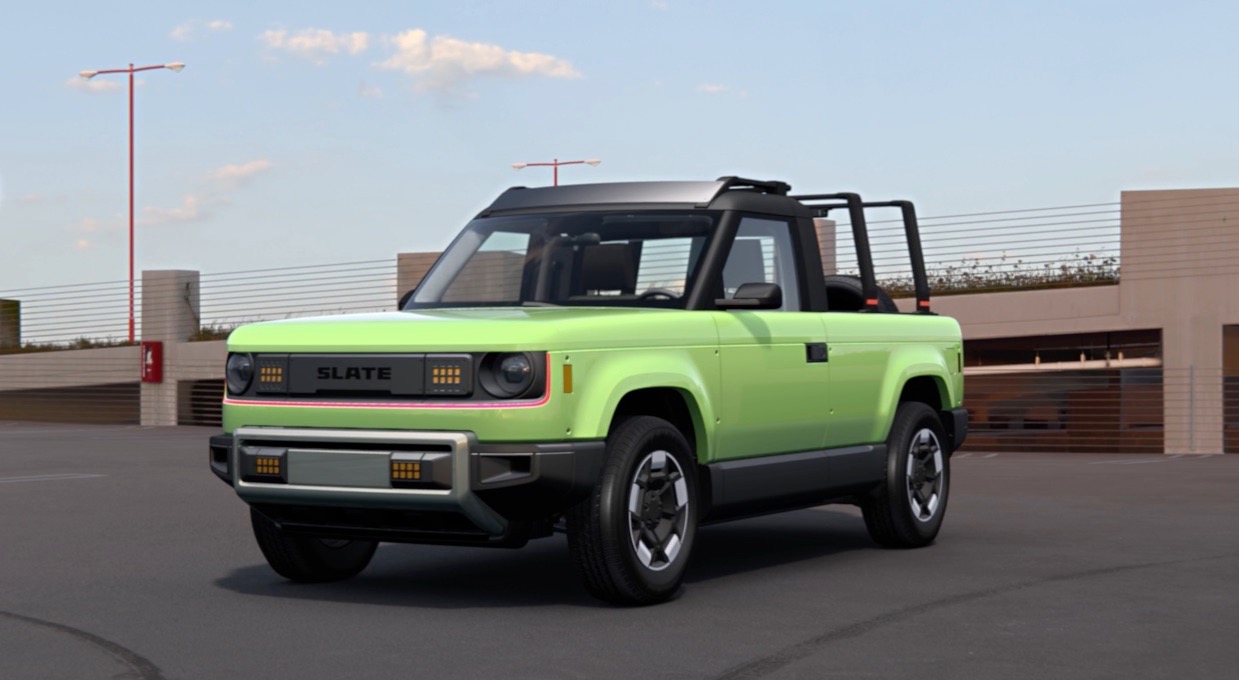
Source: Slate Auto configurator (as done by my kid)
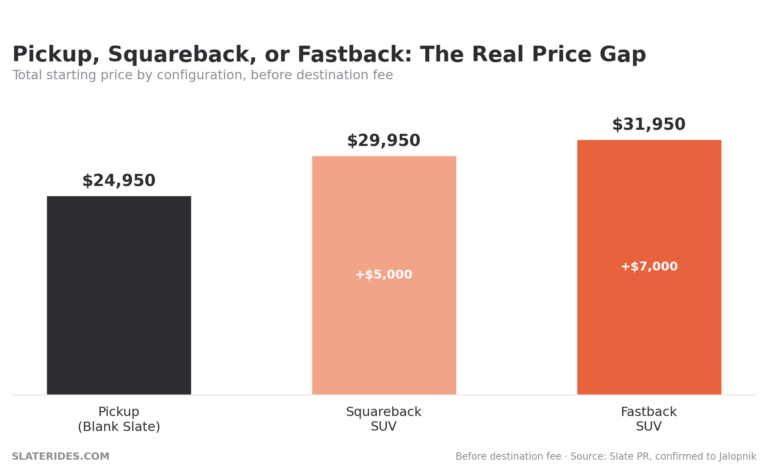
If you were somehow sequestered from the web for the last few weeks, perhaps exploring the Tonga Trench in your personal submersible, then you’ve missed all the excitement around the Slate Auto EV truck/SUV. The TL/DR is that a Bezos-backed company is going to build a Sub-$20,000 (with current incentives) EV truck that you can turn into an SUV yourself, has no paint, comes with crank windows, and offers rear airbags you can install yourself.
ADVERTISEMENT
Just here, we’ve written about the engineering, the powerplant, the fun wraps, and the whole concept of a DIY car. All of that’s important, and it all seems designed to get people to talk about it so that they, eventually, plunk down $50 to maybe buy one at some point in the future. I put in my own $50, as much out of curiosity as sincere intent to purchase.
I think all the hype around the vehicle is deserved. This is a genuinely new idea backed by an individual who can afford to see it through the difficult early stages. What’s most fascinating to me, though, isn’t what it is but how it might actually come to exist.
The car didn’t become the car, really, until it could be mass-produced. The Model T was far from the first automobile, but people think of it as the first and most important vehicle because of Henry Ford’s moving assembly line. The same could be said of the Toyota Corolla and the Toyota Production System, which allowed the Japanese automaker to expand rapidly and efficiently to compete with more established automakers.
More recently, “gigacasting” became an industry obsession as Tesla went from making Roadsters essentially by hand to building massive production facilities that produce enough Model Ys to replace the Corolla as the most popular car in the world. Gigacasting and Gigafactories became key, with giant casts reducing the number of parts required to make a car.
It’s a very Musk-ian view of production, relying on a huge sci-fi scale to achieve corporate dominance. The Bezos-backed Slate Auto has a completely inverted concept. For all the talk of how electric cars are simpler and require less complex drivetrains, the actual electric cars you can buy are enormously complex and expensive. They’re also all produced in factories that look a lot like existing car factories.
ADVERTISEMENT
Slate Auto’s first plant doesn’t sound anything like a modern car factory. Right off the bat, there’s no paint. Just last year, Toyota invested $922 million to build a new paint shop at its Kentucky plant. Painting cars is one of the hardest parts of making a modern car, and Slate Auto has entirely done away with it.
How? The body panels are dent- and scratch-resistant injection molded polypropylene composite material. Basically, it’s plastic, just like the old Saturns. If you want color on your truck, you can just wrap it, or Slate Auto can wrap it for you. This is theoretically way simpler.
It’s way more than that, though, and Tim Stevens writing for The Vergecaptures a lot of what’s interesting to me here:
Vehicle factories tend to have high ceilings to make room for the multiple-story stamping machines that form metal body parts. Injection molding of plastic is far easier and cheaper to do in limited spaces — spaces like the factory that Slate has purchased for its manufacturing, reportedly near Indiana. “The vehicle is designed, engineered, and manufactured in the US, with the majority of our supply chain based in the US,” Snyder says.
The simplification goes simpler still. Slate will make just one vehicle, in just one trim, in just one color, with everything from bigger battery packs to SUV upgrade kits added on later.
“Because we only produce one vehicle in the factory with zero options, we’ve moved all of the complexity out of the factory,” Snyder says.
Making cars is hard and expensive. At least it is if you make it the old-fashioned way. At one point last year, Rivian lost $39,130 for every car it sold, which seems bad until you find out that Lucid was losing $341,604 over the same period. Both the Rivian R1S and Lucid Air are almost certainly better vehicles than the Slate Auto EV, but there’s no way to make them as cheaply.
Over at TechCrunch, Sean O’Kane has identified the likely facility in Warsaw, Indiana, likely to be used by the company:
ADVERTISEMENT
Slate Auto, the buzzy new EV startup that broke stealth this week, is close to locking in a former printing plant located in Warsaw, Indiana as the future production site for its cheap electric truck, a review of public records shows.
The company is expected to lease the 1.4 million-square-foot facility for an undisclosed sum. Economic development officials told local media earlier this year (without naming Slate) the factory could employ up to 2,000 people, and that the county offered the undisclosed company an incentive package.
It’s probably possible to turn an old printing plant into a facility that makes modern cars, but my guess is that it would be so expensive that most automakers wouldn’t even bother. If Slate can take an existing space like this and make it work, then we could be looking at a new paradigm in carmaking.
And why stop at a truck? If this same form factor is successful, Slate Auto can find another facility and make a sedan, or a three-row SUV, or just about anything. Tesla and many other automakers are betting that anyone who can’t make a car with high processing power produced at scale with huge casts won’t survive. They may be right, but what if they’re not?